How Much Food Can I Grow in My UK Semi-Detached Garden?
If you’ve come here from one of my YouTube videos, this is where I put the full breakdown behind the numbers what I’m growing, how I’m calculating it, what I’ve learned in the garden, and what I’m testing next.
I’m semi-retired, I like figuring things out, and I’ve got a fairly ordinary UK semi-detached garden. I’ve been asking a simple question: how much useful food can I actually produce here?
This page is my working notebook for that experiment. I update it as I learn more, so the numbers and field notes will change as the garden does.
Start with the calculator, then follow my full breakdown below.
The Great Potato Conspiracy: Why My Garden Outperformed Global Agriculture
Can a small suburban garden outyield commercial farming per square metre? Watch the real-time harvest weigh-in and calorie calculations from my UK raised beds.

The Full Breakdown Behind My Videos
In my YouTube videos I can talk through an idea, show you the garden and work through some numbers. But there is only so much detail that makes sense in a video.
This page is where I put the rest.
You can check my calculations, see the crops I’m concentrating on, follow the garden experiments and come back later to see what has changed.
Use the calculator with your own available growing space.
Compare the crops I’m using and why they interest me.
See what actually happened rather than just reading a theory.
I’ll keep adding experiments, harvests and lessons as I go.
🧮 My Garden Food Security Calculator
Put in your growing area and the sort of garden you’re working with. I’ll give you an estimate of the annual calories, grocery value and equivalent food days represented by that production.
The food-days figure is based on calories only. It isn’t a measure of a complete or nutritionally balanced diet.
I’m Treating My Garden as an Experiment
I’m not trying to pretend that a suburban garden is a small farm. I’m interested in finding out what I can realistically get from the space I have.
Getting a Productive UK Garden Started
My biggest constraint isn’t simply the amount of land. It’s getting the soil, water and growing space working properly together.
If you’re dealing with heavy British clay or a small suburban plot, these are the things I’m concentrating on.
What Actually Happened in My Garden
This is the bit I expect to change most often. As I run experiments, harvest crops and learn what works, I’ll add the results here.
Testing Productive Leafy Greens in a Small Garden
I’m testing how much useful food I can produce from a relatively small growing footprint and recording what happens rather than relying entirely on theoretical yield figures.
Watch the field video ↗Why I’m Interested in Potatoes for Food Security
I’m looking at the role of calorie-dense staple crops in a UK vegetable garden and what the actual harvest tells me about growing food when space is limited.
Watch the field video ↗Building Better Garden Soil Without Constantly Buying Compost
I’m experimenting with leaf mould, garden waste and locally available organic inputs as part of the longer-term job of improving my soil.
Watch the field video ↗I’ll keep adding new field notes here as the project develops.
Crops I’m Growing in My Small UK Garden
I’m tracking the performance of the full range of crops in my garden evaluating calorie yield, food value, and performance in heavy UK clay.
| Crop | Calorie density | Food value | Clay suitability |
|---|---|---|---|
| Maincrop Potatoes | Very high | High (Staple crop) | High (Breaks up soil) |
| Beetroot & Radish | Moderate | High | High |
| Kale & Chard | Low | Very high (Greens & nutrients) | High (Very hardy) |
| Zucchini (Courgette), Pumpkin & Butternut Squash | Moderate to High | High (Heavy yield & storage) | Moderate (Needs organic enrichment) |
| Beans & Chickpeas | High | Very high (Plant protein) | Moderate to High (Fixes nitrogen) |
| Garlic, Chives & Culinary Herbs (Mint, Basil, Dill) | Low | High (Flavor & medicinal) | High |
| Tomatoes & Aubergine | Low to Moderate | High | Moderate (Needs warmth & shelter) |
| Strawberries | Low | High (High store value) | Moderate |
| Sunflowers | High (Seeds) | Moderate (Pollinators & seeds) | High |
This is my working crop comparison. I’ll use ongoing field notes to compare realistic garden outputs, storage value, and soil adaptability across the season.
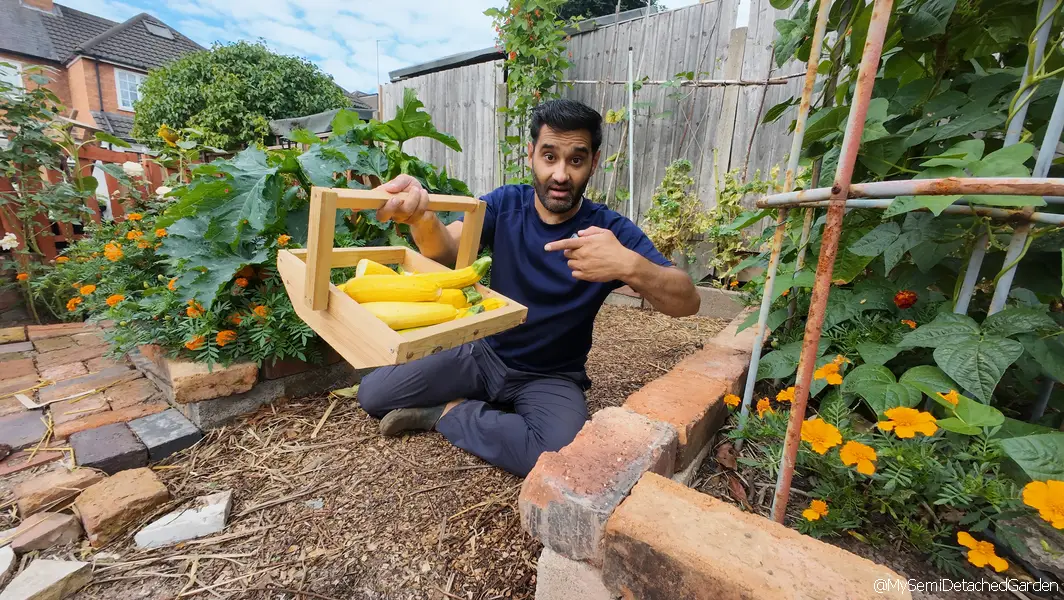
Questions I’m Trying to Answer
Can a semi-detached garden feed a family?
I’m not claiming that a normal suburban garden can replace a family’s entire food supply. What interests me is how much useful food it can contribute, particularly when I concentrate limited space on productive crops.
How much food can you grow in a small garden?
That’s one of the questions behind this whole project. The answer depends on the growing area, crop choices, soil, weather and how intensively the space is used. That’s why I’m measuring my own results rather than relying on one headline figure.
What about heavy British clay?
That’s something I’m dealing with myself. My approach is to improve the growing environment progressively rather than expect the underlying soil to become perfect overnight.
Can I grow food without using lots of mains water?
Water is another part of the experiment. I’m looking at rainwater collection, storage, soil management and crop choices to see how much I can reduce reliance on mains water.
I’m continuing the experiment on YouTube. The videos show what I’m doing in the garden; this page holds the calculations, crop comparisons and ongoing field notes.
Watch My Semi-Detached Garden ↗Fancy Working Out Your Own Numbers?
Take the number you heard in my video, put your own garden size into the calculator and then have a look through the field notes to see how I’m testing the idea in practice.
Try the Calculator ↑My Backyard Growing Footprint
A complete map and bed breakdown of our 32 m² (345 sq ft) intensive vegetable growing space.
| Bed Zone | Dimensions | Sq Ft | Sq Meters |
|---|---|---|---|
| Top L-Bed (Horizontal) | 16 × 4 ft | 64 sq ft | 5.95 m² |
| Right L-Bed (Vertical) | 30 × 2 ft | 60 sq ft | 5.57 m² |
| Top Left Ground Bed | 11 × 3 ft | 33 sq ft | 3.07 m² |
| Middle Upper Ground Bed | 10 × 3 ft | 30 sq ft | 2.79 m² |
| Middle Lower Ground Bed | 12 × 3 ft | 36 sq ft | 3.34 m² |
| Bottom Left Ground Bed | 10 × 3 ft | 30 sq ft | 2.79 m² |
| Left Border Strip | 30 × 1 ft | 30 sq ft | 2.79 m² |
| Bottom Left Wall Bed | 14 × 2 ft | 28 sq ft | 2.60 m² |
| Bottom Right Wall Bed | 13 × 2 ft | 26 sq ft | 2.42 m² |
| Center Island Bed | 4 × 2 ft | 8 sq ft | 0.74 m² |
| Total Growing Space | 345 sq ft | 32.1 m² | |